


Every decision without a written rule ends up as a message on one person device.
TL;DR
If you run two or more locations, the delay in your numbers is a symptom. The problem is that decisions still route through you, so nothing moves at a branch until you reply. Business process automation services close that gap in a fixed order. Document the decision. Name who owns it. Set the rupee limit. Then enforce it inside the system you already own.
Run the 30 day absence test before you shortlist anybody. What breaks while you are away tells you what to automate, and in what order.
Your Chennai unit closes its books on the 8th. Coimbatore closes around the 12th. The Pune branch sends its file when the accountant there gets to it. So the first consolidated payables position you see each month lands around the 15th, and you make a working capital call on numbers that are already two weeks old.
The price of that lag is not the software licence you keep postponing. It is the vendor rate revision applied at one site and not the other two. It is the discount slab a branch sales head reads his own way. It is the stock variance nobody catches until the annual count, by which point the financial year has closed and the write off is yours to explain.
You already know what business process automation services are. The decision in front of you is narrower. Which of these gaps can your own team close, which ones need somebody outside the reporting line, and what order the work has to happen in.
The delay is not caused by manual work. It is caused by undelegated judgement.
Decisions that route through you fall into three groups. Most firms fix only the first, then wonder why the close date has not moved.
- Transactional approvals. Discounts, purchase orders, payments, credit notes and petty cash, at every location.
- Exception handling. The customer who wants different terms. The vendor who missed a delivery. The branch stock count that refuses to tie.
- Relationship custody. The banker, the top five customers, the supplier who extends credit when the month gets tight.
Sound process automation clears the first group completely. It shrinks the second. It leaves the third with you, which is correct.
Why invoice capture rarely changes your close date
Data entry was never your constraint. The pause between entry and approval was. You can automate invoice capture at all three sites and still watch a Pune payment sit for six days because it waits on your reply. Measure the wait, not the typing. If you have never timed it, that single number usually settles the internal debate about where to start.
The parallel register at branch level
Your branch team enters data into the system. Then somebody keeps a separate sheet, because they do not trust the system to hold what they entered. Month end becomes a reconciliation between two records rather than a review of one. If your consolidated numbers only make sense once a private spreadsheet gets applied to them, the system is not yet your source of truth. That is the most reliable sign that the software went in but the rules never did.
Run the 30 day absence test before you shortlist a vendor
Do not actually disappear for a month. Do it on paper, across one normal fortnight.
Log every decision that reached you. Record five columns. What the decision was. Who asked, and from which location. The rupee value. How long it waited for you. And the honest answer to one question: could a written rule have decided this without me?
That final column is your automation backlog, already ranked by value and by delay.
How to read what breaks first
- What breaks in week one is a controls gap. Nobody knows the rule, so nothing moves. Written SOPs and approval limits close it.
- What breaks in week three is a capability gap. People know the rule but cannot apply judgement inside it. Training and sharper escalation criteria close it.
- What breaks only in week four is genuinely strategic. Keep it. That part is your actual job.
Most promoters find far more of the log sitting in the first group than they expected, and very little in the third.
Build the promoter dependency log
Copy this format. Fourteen days of honest entries tell you more than any vendor assessment will.
| Decision | Asked by | Value | Waited | Could a rule decide it? |
|---|---|---|---|---|
| Discount above 8 percent | Sales head, Coimbatore | INR 1.4 lakh | 2 days | Yes. Slab by dealer category. |
| Purchase order, packing material | Stores, Chennai | INR 62,000 | 3 days | Yes. Rate contract plus reorder level. |
| Credit note, damaged consignment | Accounts, Pune | INR 38,000 | 5 days | Yes, up to a set limit. |
| Terms change, new export buyer | Business head | INR 40 lakh | 1 day | No. This one stays with you. |
Where your business sits on the ladder
Place yourself here before you evaluate a single proposal, because the right first step differs at every rung.
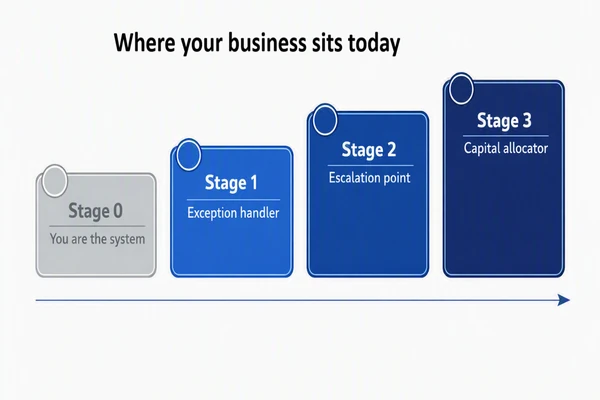
| Stage | Your role | What you notice | What fixes it |
|---|---|---|---|
| 0 | You are the system | Nothing moves without a call to you | Process mapping and written SOPs |
| 1 | Exception handler | Routine flows, oddities escalate | Authority matrix with rupee limits |
| 2 | Escalation point | Only real outliers reach you | Rules enforced inside the ERP, exception dashboards |
| 3 | Capital allocator | You review numbers, not transactions | Continuous controls monitoring, forecasting cadence |
Firms skip rungs and then fall back down. An ERP bought at Stage 0 encodes the current chaos accurately, and everyone blames the software afterwards. Deloitte Private reported in December 2025 that 53 percent of Indian family businesses already use AI in operations, ahead of global averages. Adoption is not your gap. Sequence is.
The five mechanics that actually change the numbers
Ignore feature lists in proposals. Business process automation services are worth exactly what these five mechanics deliver, so ask any provider how they intend to handle each one.
SOPs a new branch accountant can execute
Written so somebody hired last week completes the process without shadowing your best person for six weeks. Screenshots, exact field names, and a written answer for the exception your senior staff currently handle by instinct. The test is simple. Hand the SOP to the newest person at your smallest location and watch what they do with it.
An authority matrix with rupee limits
Thresholds by role and by location. Escalation triggers. Named owners. One page, approved, visible at every site. A delegation of authority matrix that lives only in a shared drive has never once stopped an unapproved discount at a counter 400 kilometres away.
Controls that sit inside the workflow
Three way match on purchases. Credit limits enforced at order entry rather than reviewed afterwards. Discount caps applied by role. The control has to live in the system, because a control written into a policy document depends on somebody choosing to follow it. This is where internal controls work and automation stop being two separate projects, and it is the same logic an internal audit review tests after the fact.
Branch reconciliation on a fixed calendar
Standardise the chart of accounts across locations first, because consolidated reporting built on three different account structures produces three different versions of the truth. Then fix the cutoff date, the same date at every site, and automate the data pull instead of requesting it. Most of the two week lag described at the top of this article closes right here.
Exception reports that reach you before the month closes
You stop requesting reports. The system tells you when something deviates. Stock variance above your tolerance. Any payment above a threshold. Any customer past agreed credit days. Silence starts to carry information, because silence now means the rules held. Firms at this stage often pair the process work with outsourced finance leadership so that somebody reviews the exception list weekly rather than at year end.
Can your own team do this without outside help?
This is the question most promoters ask last and think about first, so here is a straight answer. Parts of what gets sold as business process automation services you should not pay anybody for.
Three parts are genuinely self serve, and you will get a better result doing them yourself. Run the dependency log, because the entries mean more when the person writing them is the person being interrupted. Write SOPs for your three highest volume processes with the people who actually run them. Set the rupee limits, because only you know your risk appetite.
Two parts usually go wrong without somebody outside the reporting line.
The first is grading. The person who designed a control rarely finds its gap, and a branch head will negotiate an exception with an internal colleague in a way he will not attempt with an external reviewer. The second is configuration. Your ERP partner builds exactly what you specify, which is not the same as what the control requires, and the difference surfaces during the first audit after go live rather than during the project.
PKC keeps process consulting, audit and assurance, and taxation under one roof for that mechanical reason. A control designed in the process room gets tested later by a different team in the audit room. The firm has run that structure since 1988. The business process automation service page sets out how the process side is scoped and staged.
Where the money leaks, by operation type
These are the gaps where business process automation services repay the effort first, so start with the one that matches your largest unit.
Manufacturing and supply chain
Vendor rate revisions applied at one plant and not the others. Rework nobody costs, so your product margin reads better than it is. Third party risk sitting outside any register. Lock the rate master to approved revisions. Cost rejections at source. Review the risk register monthly, because your vendor base changes faster than your audit calendar does.
Retail and franchise networks
Stock variance across stores. Discounts approved at the counter by whoever happened to be standing there. Franchisee reconciliation running a month behind. Enforce discount limits at point of sale and report variance by store daily. Leakage here is usually measurable inside one quarter, which makes a retail arm the easiest place to prove the case internally before extending the work to other units.
Projects and real estate
Milestone billing that lags site progress. Subcontractor advances with no recovery schedule. Trigger billing from verified site milestones. Schedule advance recovery at the moment of release rather than the moment somebody remembers.
What you should not automate
Rules based decisions automate well. Judgement calls carrying reputational, relationship or regulatory weight should stay with a person and simply become visible to you.
Two warnings. Do not automate a broken process, because you will get wrong answers faster and at three sites instead of one. And do not present the project internally as a headcount cut. In most mid market firms the same team ends up handling far more volume, and that is the honest return to put in front of your board.
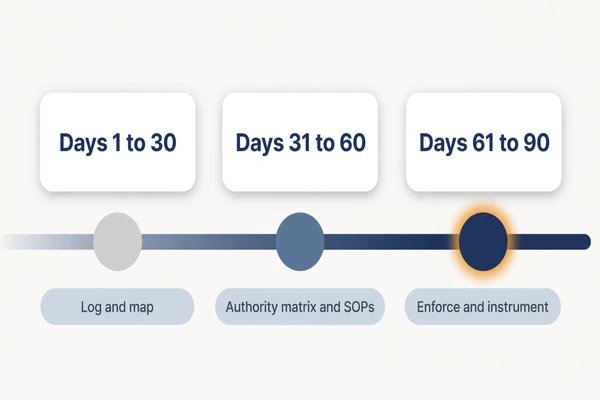
A 90 day sequence that does not stall
- Days 1 to 30. Run the dependency log. Map your three highest volume processes as they actually run at each location, not as the org chart claims.
- Days 31 to 60. Write the authority matrix. Write SOPs for those three processes. Name a process owner at each site who is not you.
- Days 61 to 90. Configure enforcement inside the system you already own before buying a new one. Switch on exception reports. Retire the parallel register.
Track five numbers from day one. Decisions routed to you per week. Average approval wait time. Days to close books. Exception rate by process. Recovered leakage value. If those five move, the work landed. If only your licence count moved, it did not. A structured audit and assurance review at day 90 keeps the scoring honest, because the person who built the process should not be the only person grading it.
Common mistakes to avoid
- Buying software before mapping the process.
- Writing SOPs in a conference room without the person who does the work.
- Setting approval limits so low that everything escalates to you anyway.
- Running the old register in parallel just for a month, then never stopping.
- Rolling out to every location at once instead of proving it at one.
- Measuring adoption by logins instead of by decisions you no longer touch.
FAQ
How are business process automation services different from an ERP implementation?
An ERP gives you a place to record transactions. Business process automation services decide what the transaction is allowed to be in the first place. Process mapping, control design and the authority matrix come first, and the ERP then enforces them. Reverse that order and the software speeds up your existing habits at greater cost.
We run the same software at every location. Why do the numbers still differ?
Almost always because the master data differs. Different chart of accounts structures, different item codes for the same material, different cutoff dates for month end. The software is identical and the inputs are not, so consolidation turns into a manual mapping exercise every month. Standardising masters and cutoff dates usually recovers more time than any new module you could buy.
At what size does this become worth doing?
The trigger is structural rather than financial. Start when you open a second location, cross roughly 40 to 50 people, or add a second product line. Each of those multiplies the number of decisions without multiplying the number of people allowed to make them, which is exactly when the promoter becomes the bottleneck.
Will this reduce my headcount?
Usually not. The same team handles more volume, and roles shift from data entry toward review and exception handling. Projects presented internally as a headcount cut tend to meet quiet resistance, incomplete data and a stall around month four.
How long before this shows up in my numbers?
Approval wait times drop within weeks, because the authority matrix takes effect immediately. Leakage recovery in inventory and discounting typically shows inside one quarter. Book closure speed and forecasting accuracy take two to three quarters, since both depend on a full cycle of clean data.
Why do these projects stall in promoter led businesses?
Because the promoter approves the project and then keeps approving the transactions. Staff read that correctly and route decisions the old way. The fix is unglamorous. Name the decisions you will no longer take, tell your branch heads, and hold to it for a full quarter.
The point was never to be unreachable
It was to make your reachability optional.
Start with the log. Fourteen honest rows across one normal fortnight will show you how much of what reaches you is judgement, and how much is a rule that nobody ever wrote down. Most promoters are surprised by the ratio, and that surprise is what makes the rest of the work easy to fund internally.
Everything else that sits under business process automation services follows from those rows. If you would rather work through your first fourteen with somebody who has read a few hundred of them, Schedule an Appointment and we will go through them with you.
